Laundry services in the professional sector are often handled by a dedicated laundry department, encompassing everything from washing and folding to ironing and storage before distribution. Discover our full range of detergents and additives for professional laundry needs.
What is a professional or industrial laundry?
When the quantity of laundry to be processed becomes significant, there are two possibilities for the establishment.
Either internalize the laundry processing through a structure that will ensure this mission from A to Z, starting with the collection of dirty laundry usinglaundry collection trolleys , up to distribution and storage.
Either outsource to a service company (so-called industrial laundry) which will collect the laundry from your facility, process it externally and then bring it back to you ready to be distributed.
A laundry is the place where laundry is washed.
Therefore, this internal or external structure encompasses all activities related to laundry:
- Preparing laundry for washing: sorting, weighing, etc.
- Laundry
- Drying and ironing
- Stored before reuse
The different types of professional machines encountered
Several categories of machines need to be distinguished.
Machines in the 10 to 34 kg category are considered professional models.
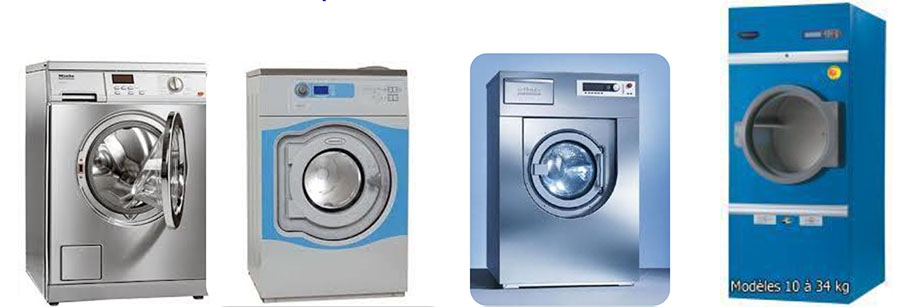
We distinguish between smaller machines which are called semi-professional machines.
They will be intended for small units such as nurseries, care homes, small restaurants...
In this context, the use of powdered or liquid laundry detergent, or even laundry tablets, will be more than sufficient as a solution for washing clothes.
Understanding the vocabulary used in laundry
When you work in a laundry, whether in a hotel, retirement home, nursing home, clinic, etc., specific terminology is used to designate the tasks and equipment.
Here is a summary of what you can expect to hear.
| Launderer's term | Meaning |
| Small dish | pillowcases, bolster covers, napkins |
| Large dish | bed sheets, mattress protectors, bedspreads |
| Resident's linen | residents' clothing |
| Restaurant linen | dish towels, aprons |
| Sponges | bath towels |
| Work clothes | blouses, tunics, blues |
| Mop and fringes | cleaning cloths, fabrics used for cleaning |
| Decatir | of linen, that is to say, to remove the finish from new linen, to take away its luster (shine) |
| Rewash rate | % of washing machine |
The rewash rate refers to the percentage of laundry that needs to be rewashed due to unsatisfactory results. Generally, the maximum acceptable rate is 4 to 5%.
It is very rarely equal to zero except when washing very lightly soiled laundry.
The rules for washing laundry in a laundromat
The quality of laundry washing in laundries, whether industrial or internalized, depends on 4 parameters which can be summarized by this acronym: SENS.
This acronym is easy to remember because it represents common sense practices.
What does each letter of this acronym mean?
The S indicates the type of textile to be cleaned.
The letter E indicates Water and its chemical characteristics.
The N indicates Cleaning in the sense of the method to be used
The letter S indicates the soiling to be removed during laundry washing.
Let's look at each of these parameters in detail:
Impact and rules for the textile support to be washed
In laundry, the support to be washed and the linen can take different forms in terms of materials and use.
The main objective of laundry in a professional setting is to restore the laundry to its original appearance by limiting potential wear and tear due to successive cleanings.
The aim is therefore to restore the brightness and colors, and especially in institutional settings, to ensure impeccable hygiene for treated textiles. A wide variety of textile configurations are involved, which will lead to adjustments in the amount of chemicals, the temperature, the mechanical action of the washing machine, and the possible presence or absence of chlorine .
S - Textile and fiber support
This table summarizes the recommendations by type of textile.
| Resistance | Cotton/Linen | Wool / Silk | Synthetic fibers | Polyester cotton |
| Chemistry | Good | Weak | Good | Good |
| Temperature | Very good | Very weak | Weak | Average |
| Mechanical action | Good | Very weak | Weak | Average |
| Chlorine | Average | Very weak | Weak | Average |
E - Characteristics of Water
The chemical properties of water are rarely considered, whether for laundry, dishwashing, or even simply for the daily cleaning of floors and surfaces that use water. However, water hardness directly impacts the results .
In the world of laundry, this hardness affects the quality of the wash, it makes the laundry grey and of course it affects the machines.
Therefore, particular attention must be paid to the installed water softener system and the proper leveling ofsoftener salts, which ensures its correct operation. Regular monitoring of the water hardness (TH) is necessary.
A second, even less taken-into-consider element is the presence of metallic salts dissolved in the water .
They cause yellow stains on laundry. They damage the fabric's texture. They turn some stains brown.
N - Cleaning and washing method of laundry
The cleaning action can be described using Sinner's Circle but adapted to washing laundry.
Thus, the mechanical action will correspond to the machine's " load level ." The more your machine is loaded, the less possible it will be to agitate the laundry and therefore the less mechanical action will be possible.
The action time corresponds to the contact time with the products during the chosen wash cycle.
The action of temperature accelerates the chemical reaction, emulsifies the greases and ensures disinfection.
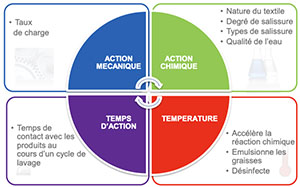
The temperature action accelerates the chemical reaction , emulsifies the greases and ensures disinfection.
The chemical action will be adapted according to the nature of the textile, the degree and type of soiling and the quality of the water (presence of sequestrant in the product or not).
What laundry load capacity is needed for good results?
The load size refers to the amount of laundry put in the washing machine. If this amount is incorrect, whether under- or over-loaded, the results will be less effective. The load size is directly related to the type of laundry being washed.
Summary of load rate by type of laundry and cycle.
| Type of linen | Load rate |
| Slightly soiled sponges/cotton | 100% |
| Moderately soiled cotton and linen | 90% |
| Decontamination | 66% |
| Polyester cotton | 66% |
| Wool and silk | 50% |
How can I determine the volume of the drum?
_UK_