More than 80% of the dirt present in a company or community building is brought in by the soles of shoes or the wheels of various trolleys coming from outside.
Carpets in public spaces: an essential link in hygiene
The dust-control mat is a piece of equipment that helps ensure hygiene in public spaces because it will greatly reduce dust and airborne germs, but will also of course reduce maintenance and cleaning operations.
Now, while choosing a professional dust-control mat might seem simple at first glance, we'll try to understand how to make the most effective choice based on the traffic and its location. The characteristics of a mat designed for heavy traffic and high-traffic areas will be radically different from those of a scraper mat .
We will also see that in the event of heavy traffic, the two can be "coupled" to obtain the best efficiency.
In this expert guide, you will discover the real selection criteria, the pitfalls to avoid, and how to invest in equipment that will not only preserve your company's polished image but also optimize the comfort and safety of your employees.
Feel free to contact our advisors who will guide you in your choice.
What a professional dust-control mat really is
A professional dust-trapping mat is not simply an enlarged version of the household doormat everyone uses at home. These mats, used in public spaces , significantly improve cleanliness and the image conveyed to visitors of your establishment, whether private or public. Whether the mat is placed at the entrance of a hotel, a business, a town hall, etc., it reflects the establishment's image to the user.
Difference between domestic use and professional use
Professional mats are distinguished by their more sophisticated design and materials compared to household mats. Unlike domestic models, a true professional dust-control mat boasts superior absorption capacity, increased resistance, and durability, designed to withstand heavy foot traffic. The traffic that a home mat sees ranges from a few dozen people per day to over 1,000 daily in a public establishment .
It is therefore normal that the product is clearly not identical at all, nor at the same price...
These mats are designed to trap up to 95% of dirt and moisture from the first steps.
Furthermore, professional mats meet specific technical requirements:
• A certified slip-resistant sole for high-traffic environments
• Fire-retardant materials meeting fire safety standards ( carpets classified Bfl-s1 or Cfl-s1 according to standard EN 13501-1)
• A thickness suitable for use by people with reduced mobility (PRM) and for wheelchair access.
Carpet cleaning and maintenance
Regular maintenance and cleaning are essential to preserve the performance of your carpet. Even the best carpets, like the 3M Nomad range, quickly lose their effectiveness without proper cleaning. Daily maintenance should be carried out with a professional vacuum cleaner , preferably one with HEPA filtration to prevent excessive dust recirculation.
The purpose of the mat is to capture this dust to prevent it from becoming airborne; it would be foolish to release all these germs into the atmosphere using a "mediocre" vacuum cleaner...
Cleaning can be done by machine washing at 30° or 60° depending on the manufacturer's recommendations.
A deep cleaning without machine washing should be done with a carpet extractor and a cleaning product that will revive colors and remove dirt and germs embedded in the fibers. A poorly maintained carpet has saturated fibers that can no longer absorb moisture. Remember that such equipment reduces the concentration of allergens in the air and improves air quality.
A properly maintained and sized absorbent dust mat reduces floor cleaning costs by 70% and extends their lifespan.
The mat reduces the risk of falls and slips.
The safety function is often overlooked, but it remains essential in any establishment open to the public. In wet or inclement areas, a large dust-absorbing mat reduces the risk of falls by 80% , thus contributing to the prevention of workplace accidents. Its ability to quickly absorb liquids, mud, gravel, or any other foreign matter that could cause a slip ensures a safe surface even during periods of high traffic. However, in heavy rain or very wet areas, it is still necessary to indicate a potential risk of slipping or falling with a " slippery floor" sign .
Manufacturing and environmental compliance REACH
For many years, Voussert has been committed to offering you more sustainable products. We were the first to guarantee products that are 100% compliant with REACH regulations and free of hazardous or concerning substances. We have also improved some of our products by replacing PVC soles with natural latex soles to limit the use of non-renewable raw materials. Today, we are proud to offer you a wide range of recycled and recyclable rugs that are more environmentally friendly and aligned with the principles of a circular economy.
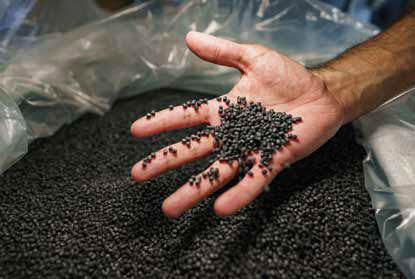
Our rugs are made in Belgium in a carbon-neutral factory , from industrial waste which is recovered and transformed to make the sole of our rugs.
The absorbent and scraping fibers are sourced locally, always prioritizing recycled materials. The result is a recycled, recyclable rug that complies with REACH regulations.
At the end of its life, this rug can be recycled in our factory to make a new rug.
The eco-friendly carpet manufacturing process in detail
Most carpets are manufactured in India or Asia. While there's no real European alternative for our rubber grating range , for example, we've chosen to partner with a factory in Belgium for our dust-control mats. This ensures the most eco-responsible manufacturing possible.
Raw materials: Recycling of post-production waste from the automotive and medical industries and recycling of our carpets.
Extrusion: Transformation of waste into synthetic rubber granules.
Production: In an eco-friendly production facility, locally sourced textile fibers and recycled granules that form the sole are combined to make a rug.
The final product: A recycled, recyclable rug, free of PVC, phthalates, and compliant with the REACH SVHC standard!
At the end of its life, this rug can be recycled again in our factory to make a new rug.
Types of dust-control mats and their specific uses
Each model will correspond to parameters related to the environment and traffic level.
Scraping mat vs. absorbent mat
The choice between these two technologies depends on your environment. The scraper mat, with its rough polyamide surface, effectively removes large dirt and debris embedded under shoes. Its mechanical action is particularly well-suited to outdoor entrances and high-touch areas.
Furthermore, the absorbent mat, made of dense polyamide fibers, captures moisture and retains fine particles . Its absorption capacity helps keep floors dry even during inclement weather. For maximum effectiveness, some manufacturers now offer tri-zone mats combining scraping and absorbent zones, thus providing a complete barrier against all forms of soiling.
Mats for pits and high-traffic areas
In high-traffic areas (more than 1500 daily passages), a mat specifically designed to meet these demands is the right choice. These models have a total height of 8 mm and a total weight of up to 3600 g/m², guaranteeing stability and crush resistance.
Carpet recesses are an ideal solution for main entrances. The carpet, held perfectly in place, retains its full effectiveness without slipping.
However, be aware: these installations require exact dimensions and a standard rug will not be suitable.
The most common type of mat used in pits is the coir scraper mat , available in several thicknesses (17, 22, 23, and 25 mm) and cut to size . This brush mat is placed at the entrance of buildings to remove debris from shoe soles. However, a coir brush mat has virtually no absorbency.
.jpg)
Customization becomes necessary when your configuration requires precise dimensions, especially for recessed pits. A custom-made mat ensures optimal coverage of the walkway and eliminates unprotected areas.
Custom rug manufacturing can also be a way to incorporate your visual identity. Logos, patterns, and specific colors transform a simple functional item into a communication tool that enhances your professional image.
Large format dust-control mats: for which environments?
Large formats are available in long rolls. They are particularly well-suited to the lobbies of commercial buildings, government offices, and shopping centers. Their large surface area ensures that each visitor takes enough steps (at least three) to effectively remove dirt.
These large formats offer superior technical characteristics, including a Cfl-s1 fire rating that meets the requirements of establishments open to the public (ERP), as well as certification for the passage of people with reduced mobility.
What manufacturers don't tell you about the selection criteria
Beyond the marketing claims, several characteristics of dust-trapping mats are rarely mentioned by manufacturers in their technical specifications. Yet, these elements determine effectiveness and suitability, especially in professional settings where results and, above all, safety are paramount.
Materials: Advantages and Hidden Limitations
Nylon, particularly prized for its robustness in heavy traffic, offers excellent stain resistance and ease of maintenance. However, its high price is rarely mentioned. Polypropylene is an economical alternative for moderate traffic, but its durability is limited. As for coconut fiber, its eco-friendly appearance often masks its poor resistance to harsh weather conditions. Rubber, ideal for wet areas, offers remarkable longevity but less comfort. Aluminum profiles, while very effective, require specific maintenance that is often overlooked.
Dimensions: common mistakes to avoid
The most common mistake is choosing an undersized mat. For optimal effectiveness, you should allow at least three steps across the mat. Experts recommend a length of approximately 2 meters, and sometimes up to 6 meters for complete protection. Also, be mindful of doors: a mat that is too thick can obstruct their operation. It's better to use two complementary mats rather than one oversized one: a scraper mat for the outside and an absorbent one for the inside.
Accessibility and safety standards are often ignored.
In public buildings, carpets must comply with strict standards that are rarely explained. Legislation stipulates that the carpet must not create a step higher than 2 cm to facilitate wheelchair access. The spacing between the profiles must also not exceed 2 cm. The carpet must withstand a load of at least 350 kg per point of contact. Regarding fire resistance, prioritize carpets classified as Bfl-s1 or Cfl-s1 according to standard EN 13501-1.
Actual durability and economic cost depending on traffic
Manufacturers rarely categorize their products precisely according to traffic levels. In reality, light traffic corresponds to fewer than 250 people per day, moderate traffic between 250 and 1500, and heavy traffic to more than 1500. For heavy traffic, only certain materials such as nylon or nitrile rubber offer sufficient resistance.
The thickness of the carpet should be proportional to its exposure and traffic.
The price of the product will of course be directly related to the thickness and quality of fiber used.
Hidden costs: maintenance, replacement, installation
The initial investment is only the tip of the iceberg. Regular maintenance is essential: daily vacuuming, weekly checks of spacing, and monthly inspections of the structure for recessed mats. Recessed mats require the construction of a pit, representing a significant additional cost. Furthermore, the actual lifespan varies considerably depending on the quality of maintenance and the accuracy of the initial sizing.
Expert advice for a sustainable and effective choice
To maximize the efficiency of your investment, installation and maintenance strategies play a role that is just as crucial as the initial choice of carpet.
Why combine several types of mats for greater efficiency?
The strategic combination of different mats creates a progressive barrier system against dirt. Place a scraping mat on the outside to remove coarse debris, then an absorbent mat on the inside to capture residual moisture. This phased approach can eliminate up to 95% of contaminants before they reach your main flooring.
How to read a product datasheet
First, examine the total weight in g/m² – a reliable indicator of the carpet's density and durability. Next, check the overall pile height, which influences absorption and retention capacity. Don't overlook the fire rating and accessibility certifications for people with reduced mobility (PRM). Finally, the warranty often reflects the manufacturer's confidence in their product.
When to choose an absorbent dust-trapping mat
Use this type of mat indoors after a scraper mat, or directly in areas where moisture is the main risk. It is particularly recommended for rainy regions or entrances leading directly outside without an airlock.
Tips to extend the life of your rug
Daily vacuuming removes 90% of particles before they become embedded. Rotate your rug regularly to even out wear. For stubborn stains, use only carpet stain removers or a carpet extractor/spray cleaner, or a rotary floor machine for larger areas. Feel free to move your rug slightly to prevent localized wear in high-traffic areas.
_UK_