The melamine sponge, often called a "magic sponge," is a common cleaning tool used by both professional cleaning companies and individuals for removing stains at home. Cleaning or removing stains without using chemicals is the best way to limit environmental impact and the adverse effects of chemicals, especially those found in professional formulations. The so-called "magic sponge" is one of the surface and floor cleaning tools that meets these cleaning requirements.
Voussert, a specialist in professional hygiene since 1981 , sources its melamine sponges directly from manufacturers in Asia, eliminating intermediaries . This allows us to offer competitive pricing while guaranteeing quality and a format specifically designed for professionals . This guide is written for site managers, cleaning companies, local authorities, hotels, and healthcare facilities: in this article, we will detail how the sponges work, compatible surfaces, precautions to take, the actual cost per sponge, and criteria for making the right purchase.
The magic melamine-based sponge for effective action
A powerful cleaning tool for removing marks and stains
Maintaining surfaces or floors in professional or community settings can sometimes be difficult and require the use of powerful products that are not necessarily environmentally friendly to achieve effective results.
In addition to this , the time spent, particularly with cleaning companies , can seem excessive and reduce the operating margin on the construction site. One effective tool is the melamine magic sponge , a revolutionary cleaning tool capable of tackling even the most stubborn stains with surprising ease thanks to the properties and action of melamine.
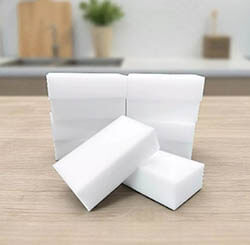
Melamine, in the form of a simple sponge or a double-sided magic sponge with an abrasive, as well as discs for single-disc floor machines, offers numerous advantages. This remarkable product, from its composition and varied uses to its benefits and the precautions to take when using it, is truly remarkable. Major brands have developed their own magic sponges, such as Vileda with its Miraclean magic sponge or 3M Corporation with its Scotch-Brite magic sponge .
A seemingly ordinary melamine sponge or floor scrubber pads can enhance your cleaning routine, offering an eco-friendly and economical alternative to traditional chemicals. Whether you're a cleaning enthusiast or simply looking for practical solutions to keep your premises, surfaces, and floors spotless, here's how to optimize their use and fully benefit from their exceptional performance.
What is a professional magic sponge?
A magic eraser is a melamine-formaldehyde foam, a hard and stable thermosetting resin, transformed into a three-dimensional network of fine, open-cell filaments. This structure offers a very large surface area for dirt to adhere to. Professional versions differ from consumer versions in their size (often larger), their multipack packaging, and their unit cost, sometimes with an abrasive side or a sponge backing to protect fingers. Its unique composition makes it a versatile and effective sponge, capable of cleaning virtually any surface and removing almost any stain or mark.
This material, present in sponges or discs for single-disc scrubbers or automatic floor scrubbers, allows for cleaning without the use of cleaning products or chemicals . This substance, initially developed for its sound insulation qualities, has proven to be an excellent cleaning material thanks to its unique microscopic structure.
How does a magic sponge work?
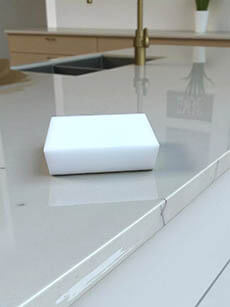
It cleans by fine abrasion: when moistened, it acts like very fine emery paper whose filaments penetrate the pores of the surface and remove surface dirt.
- Water lubricates the friction and helps the cavities to trap the detached particles.
- When dry, the foam is hard and brittle: it must always be moistened and wrung out without twisting it.
- It is effective on pencil marks, felt-tip pen marks, sole and trolley marks, light grease stains and surface limescale.
On which surfaces can a magic sponge be used, and which should be avoided?
The magic sponge is suitable for hard and abrasion-resistant surfaces; it should be tested or avoided on glossy, varnished or fragile finishes.
| Surface | Verdict | Precaution |
| Tiles, earthenware, ceramic sanitary ware | Adapted | Rinse with clean water; test on very porous joints |
| Hard plastic, vinyl, linoleum (sole marks, trolley marks) | Adapted | Rub gently, then rinse |
| Satin stainless steel, stainless steel worktops and equipment | Carefully adapted | Follow the direction of the satin finish; avoid bright polished stainless steel (micro-scratches). |
| Painted walls, doors, furniture | To be tested first | Matte or fragile paint can wear off: test on an inconspicuous area |
| Leather, waxed wood, polished marble | Definitely worth trying | Check for scratch resistance before use. |
| Varnished wood, glossy lacquer, screens, non-stick coatings | Avoid | Risk of tarnishing and micro-scratches |
| Dishes, utensils, surfaces in direct contact with food | Not recommended | Use a food-grade cloth or swab (see HACCP section) |
Its strengths and advantages
Action of the micro-abrasive surface: The faces of the sponge and these micro holes act like tiny blades, capable of "scraping" away dirt at a microscopic level without damaging most surfaces.
High absorption capacity: The cavities allow the sponge to retain water and dirt, making them easier to remove.
Relief action: The foam structure makes the sponge flexible and adaptable to different surface shapes.
The magic sponge's resistance to wear: Despite its apparent softness, melamine is a durable material that withstands repeated use well.
The density of the melamine foam plays a major role in the sponge's effectiveness. An optimal density ensures a balance between abrasiveness and the softness needed to avoid damaging delicate surfaces.
Microplastics, safety, HACCP: what we really know
The magic sponge is a plastic resin that wears down with use: it releases melamine fibers, which means it should be used only when appropriate and cleaning practices must be adapted accordingly. In this context, users in professional settings, particularly in kitchens, may wonder about hygiene and the potential for particles of material to come into contact with food.
What the study says about microplastics
A team from Nanjing University published a study in 2024 in the journal Environmental Science & Technology showing that a melamine sponge releases approximately 6.5 million fibers per gram of material lost when rubbed against a rough surface. The authors observed that less dense sponges degrade more quickly. The study documents the release of fibers into wastewater; it does not, on its own, demonstrate any health effects for the user.
Best practices for limiting emissions
- Reserve the sponge for targeted stain removal; for routine cleaning of large surfaces, prefer a cloth or a suitable detergent.
- Rub without pressing: material loss increases with pressure.
- Replace the sponge as soon as the foam starts to break down or the white side deteriorates.
- Retrieve the residue with a damp cloth rather than rinsing it directly down the drain.
- Wear gloves during prolonged use: the foam is abrasive to the skin.
Food areas and HACCP
Under current regulations, no law prohibits the professional use of melamine sponges, but as a precaution, do not use them on dishes, utensils, or surfaces that come into direct contact with food. On walls, tiles, and stainless steel equipment in a kitchen, rinse thoroughly and incorporate their use into your Food Safety Management Plan. For routine cleaning of workstations, HACCP-compliant kitchen cloths remain the appropriate color-coded tool.
Magic sponge, washcloth, stamp or disc: which to choose?
The magic sponge is for spot cleaning; the rest of the cleaning requires other tools.
- Spot stain removal (marks, traces): melamine magic sponge.
- For heavily soiled stainless steel surfaces and pans: use a stainless steel sponge or an abrasive scouring pad .
- Intensive manual scouring: Scotch-Brite 3M scourers .
- For cleaning large floors: the melamine disc for single-disc machines (maximum speed of 200 rpm, grey or white side facing the floor)
Which magic sponge should you choose? Comparison and cost per sponge
The large Voussert format is the most economical option for volumes, while the Scotch-Brite 3M offers a sponge backing and the version with abrasive targets stubborn marks.
| Reference | Format | Packaging | Price excluding VAT | Price excluding VAT / sponge | Recommended use |
| Large melamine magic sponge (Voussert) | 120 x 70 x 35 mm | Pack of 10 | €2.49 | 0.25 € | Regular stain removal, large volumes, communities |
| Melamine magic sponge with abrasive | 250 x 115 x 25 mm | x 6 | €17.90 | 2.98 € | Stubborn black marks, plasticized surfaces |
| 3M Scotch-Brite Magic Sponge | 130 x 98 x 30 mm | Box of 12 | €19.12 | 1.59 € | Sponge holder protects fingers; offices, schools, healthcare facilities |
| Melamine discs for single-disc floor machines | Ø 100 to 720 mm | Sets of 5 | According to diameter | — | Very dirty floors, black marks, up to 200 rpm |
Example calculation: for 120 sponges, 12 packs of large-format melamine magic erasers cost €29.88 excluding VAT, compared to €191.20 excluding VAT for 10 boxes of 3M Scotch-Brite magic erasers. The sizes and finishes differ (the 3M eraser has an integrated sponge backing), but the difference in unit cost is significant for large volumes. For plastic surfaces or stubborn black marks, the abrasive version is an alternative. Prices excluding VAT were observed in October 2026 and are subject to change.
A few questions about the melamine magic sponge
What is a professional magic sponge?
It's a micro-abrasive melamine-formaldehyde foam, sold in large formats and in packs, which removes stains and ingrained dirt with just water. It acts like very fine sandpaper: it's used for stain removal, not for routine cleaning.
Is the magic sponge really chemical-free?
It can be used without detergent, but it is not a "natural" material: it is a thermosetting plastic resin (melamine-formaldehyde). Its effectiveness comes from its physical structure, not from any added product.
Does the magic sponge release microplastics?
Yes, like any plastic foam that wears out. A 2024 study from Nanjing University published in Environmental Science & Technology measured approximately 6.5 million fibers released per gram of material lost. Use it for targeted stain removal, without pressing, and replace it as soon as it starts to disintegrate.
Can a magic sponge be used in a professional kitchen (HACCP)?
Yes, it can be used on walls, tiles, and stainless steel equipment, but rinse thoroughly. Avoid using it on dishes, utensils, and any direct contact with food, and incorporate its use into your Food Safety Management Plan.
On which surfaces should you not use a magic sponge?
Avoid varnished wood, glossy lacquers, screens, and non-stick coatings, which may dull or scratch. On painted surfaces, leather, or polished stainless steel, always test an inconspicuous area first.
What is the difference between a large magic eraser and a 3M Scotch-Brite?
The XL Voussert format (120 x 70 x 35 mm) is sold in packs of 10 at a very low unit cost, suitable for large volumes. The 3M Scotch-Brite (130 x 98 x 30 mm) includes a sponge backing that protects fingers and is sold in cartons of 12, at a higher unit price.
Where can I buy magic sponges at the best price for a community or cleaning company?
Voussert offers magic sponges in professional packs, sourced directly from manufacturers. Prices excluding VAT and availability are displayed on each product page; for large quantities, please contact our sales department.