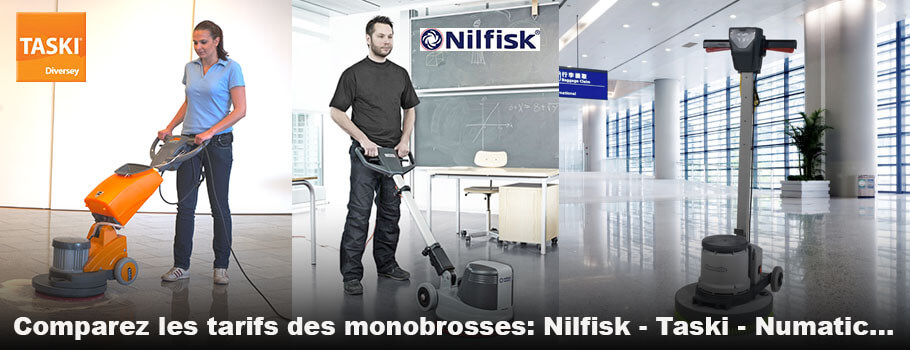
What are the types of single-disc floor machines?
The low-speed single-disc floor machine is the most common type used in professional floor cleaning because it can handle almost any task . The rotation speed is generally between 150 rpm and 250 rpm . The operations this single-disc machine allows you to perform primarily include floor cleaning with green or blue pads, floor stripping with black or brown pads, carpet cleaning , low-speed spray cleaning with red pads, and crystallization , provided the machine's weight allows it.
Single-disc floor machine with a rotation speed between 380 and 450 revolutions per minute.
This single-disc floor machine is primarily intended for floor buffing and polishing . Its use is strictly limited to the spray method (buffing) or operations that do not require significant motor torque. It must absolutely not be used for operations that place a high demand on motor torque, such as floor stripping or carpet cleaning . This would seriously damage the motor of your single-disc floor machine. Therefore, it cannot be used under any circumstances for stripping, carpet cleaning, or floor cleaning.
Their use is strictly limited to the spray method (polishing).
In this context, the single-disc machine must be equipped with a shock-absorbing pad specially designed for high-speed use in order to closely follow the shape of the floor and thus avoid any risk of surface "sanding".
The high-speed single-disc floor machine can also be used to polish parquet or marble floors. It's possible to use
specific soft parquet brushes or polishing brushes . The pads should also be
low-abrasive, such as white or beige pads , with no friction to prevent damage to the machine.
The dual-speed floor scrubber has a selector switch allowing it to operate at two different speeds. This change in rotation speed is often achieved via a selector switch that effectively doubles the base speed of the floor scrubber .
For example, consider a single-disc floor scrubber with a low speed setting (e.g., 190 rpm) and one with double that speed (380 rpm). In this case, you'll find several options such as 150 rpm/300 rpm from Numatic, 165 rpm/330 rpm from Taski, 185 rpm/370 rpm from Nilfisk, etc.
A single-disc machine with two speeds or two speeds will allow you to treat virtually all tasks from stripping, to carpet cleaning, high-speed spray, polishing method,
marble crystallization , cleaning...etc.
The downside of using this type of single-disc floor machine is the
importance of selecting the correct rotation speed, as this can
seriously damage your machine . Indeed, as explained in the previous section, high-speed stripping, for example, should be avoided.
As you will have understood, it is an all-in-one machine, but one which requires training for the agents.
Taski has recently innovated with the
Taski Flex single-disc scrubber, which offers 3 rotation speeds and a lithium battery power supply.
It is a single-disc floor machine with a speed ranging from 1200 rpm to 1500 rpm or even 2000 rpm.
This single-disc floor scrubber moves in a straight line thanks to a stabilizing wheel at the front, in addition to the two wheels common to all machines. Therefore, unlike low-speed and dual-speed single-disc scrubbers , there is no difficulty in maneuvering it . Simply adjust the disc's contact height relative to the floor to avoid burning it (in the case of vinyl flooring) or being too high and ineffective, then push the machine.
This single-disc floor machine is designed exclusively for
ultra-high-speed polishing of thermoplastic floors treated with a
metallization process (wax or emulsion application) . The high rotation speed heats the surface, making it more resistant and, above all, shinier with a
"wet look" effect. A
specific ultra-high-speed disc is required. This method makes the surface harder and more resistant to traffic, and allows for better maintenance, particularly for disinfection and the removal of black shoe marks.
How to choose your single-disc floor machine?
Choosing the right single-disc floor machine model begins with analyzing the work or tasks you intend to perform with it. Among the operations achievable with a single-disc floor machine, the following main tasks must be distinguished:
- Stripping of tiled floors and plastic or thermoplastic floors
- Floor cleaning
- Spray polishing
- Crystallization of marble or marble stone
- Carpet cleaning using carpet shampoo, either dry or wet
This must be done by precisely defining the intended use of your machine. There are, in fact, several types of single-disc floor scrubbers. A single-disc floor scrubber is characterized by its rotation speed, which ranges from low speed to high speed to ultra-high speed. The choice of rotation speed will determine the types of work you can perform with it.
The brands: we offer three major brands of single-disc floor machines with
Numatic , Nilfisk Alto and
Taski , each with recognized expertise and
quality after-sales service. Since 1981, our experience will allow us to advise you on the choice.
The tasks to be carried out with a single-disc floor machine
The task you will have to perform will determine the choice of single-disc floor machine, and vice versa.
Indeed, depending on the type of operation to be carried out, choosing the wrong equipment can prove dangerous for the user and pose risks of soil degradation.
- Soil stripping: low speed single-disc machine - black or brown disc, or blue on delicate floors.
- Spray method for soils: high-speed single-disc floor machine 400 rpm - red single-disc floor machine
- Floor cleaning: low speed single brush - green single brush disc
- Carpet cleaning: low-speed single-disc floor machine - carpet pad or carpet brush
- Crystallization: low-speed single-disc machine - steel wool pad
- Stripping of parquet flooring: low-speed single-disc machine - micromesh disc or 3M mesh tape
- Tile cleaning: low-speed single-disc machine - perlon brush
- Scarification: low-speed single-disc machine specifically designed for scarifying
Corded or battery-powered floor scrubber?
Floor scrubbers are available in battery-powered or corded versions.
Single-disc scrubbers ,
historically, are corded like vacuum cleaners, and this represents almost the entire market for floor scrubbers. The cord requires some practice to avoid tangling it with the scrubber's pad.
However, alternatives now exist with the
Numatic 244NX and the Numatic 122NX , which offer a machine capable of performing the
same tasks as a low-speed floor scrubber with a
lithium battery and liquid suction . Undoubtedly, this alternative has appealed to many floor scrubber users.
Taski has recently innovated in the world of single-disc floor scrubbers with the
Taski Flex, a lithium battery-powered scrubber offering 3 rotation speeds:
- 120 rpm – stripping
- 150 revolutions per minute – scrubbing
- 350 rpm - polishing and spraying
Single-disc scrubber comparison
| Code | Description | V rpm | Brand | Use |
| 8003810 | Ergodisc 200 | 200 | Taski | Carpet Stripping - BV Spray |
| 8003850 | Ergodisc 165 | 165 | Taski | Stripping - Dry carpet cleaning - Crystallization |
| 7518199 | Ergodisc HD | 150 | Taski | Stripping - Intensive work - Crystallization |
| 8003890 | Ergodisc 400 | 400 | Taski | Polishing - HV method spray |
| 8004020 | Ergodisc Duo | 165 / 330 | Taski | Carpet Stripping - HV Spray |
| 8004660 | Ergodisc 1200 | 1200 | Taski | Polishing - UHV Spray |
| 8004630 | Ergodisc Omni | 900 | Taski | Dry stripping - Spray - Polishing |
| 56380056 | FM400 L | 180 | Nilfisk | Carpet Stripping - BV Spray |
| 7519535 | Ergodisc 2000 | 2000 | Taski | Polishing - UHV Spray |
| 56380058 | FM400 H | 410 | Nilfisk | Polishing - HV Spray |
| 56380061 | FM400 D | 185 / 370 | Nilfisk | Polishing - HV method spray |
| 905972 | HFM1515G | 150 | Numatic | Intensive work - Crystallization |
| 905998 | HFM1523 | 230 | Numatic | Carpet Stripping - BV Spray |
| 906011 | HFM1545G | 450 | Numatic | Polishing - Spray method |
| 905923 | HNS1550G | 1500 | Numatic | Polishing - UHV Spray |
Using a single-disc floor machine
Preparation: Check that the floor scrubber is clean and that all moving parts are functioning correctly. Fill the tank with clean water and add the recommended cleaner or detergent. If you do not have a tank, you can apply the solution manually with a mop or a large flat cloth.
Adjustment: Adjust the speed and pressure of the floor scrubber according to the surface to be cleaned and the severity of the dirt. Take care with machines that have multiple speeds, as selecting too high a rotation speed for a task requiring more motor torque may damage the motor of your floor scrubber.
Cleaning: Begin cleaning the surface by gliding the floor scrubber back and forth, ensuring the nozzle remains in contact with the surface at all times. For hard-to-reach corners and edges, use a handheld sprayer. A disc size slightly larger than the machine's diameter allows you to reach edges without risk of damage. The most common 406 mm diameter disc found on most machines is sufficient, but a 432 mm disc will give you this extra headroom .
Rinsing: Once you have finished cleaning the surface, rinse it with clean water to remove any cleaner residue.
Maintenance: After each use, empty the water tank and rinse the floor scrubber thoroughly. Store the floor scrubber in a dry, protected place.
It is important to follow the manufacturer's instructions for safe and effective use of the floor scrubber.